Disclaimer
The information provided does not constitute an offer to sell or a solicitation to buy securities. It is for informational purposes only and should not be considered investment advice or endorsement.
By proceeding, you confirm that you are an Accredited Investor under Regulation D of the U.S. Securities Act of 1933, meaning you meet at least one of the following:
• Income: $200,000 annual income ($300,000 with spouse) for the past two years, with expectation of same this year.
• Net Worth: Over $1 million, excluding primary residence.
• Professional: Holder of Series 7, 65, or 82 license.
• Entity: Business/trust with assets over $5 million, or all equity owners are accredited.
• Private Fund Employee: Knowledgeable employee of a qualifying private fund.
By proceeding, you acknowledge these criteria and accept that the information is provided solely for educational purposes.
Overview
Raise: $10M (Equity)
Traction: Channel partners: DataCaliper, Tozny; content providers: Salt & Stream, Jay Gardner
About
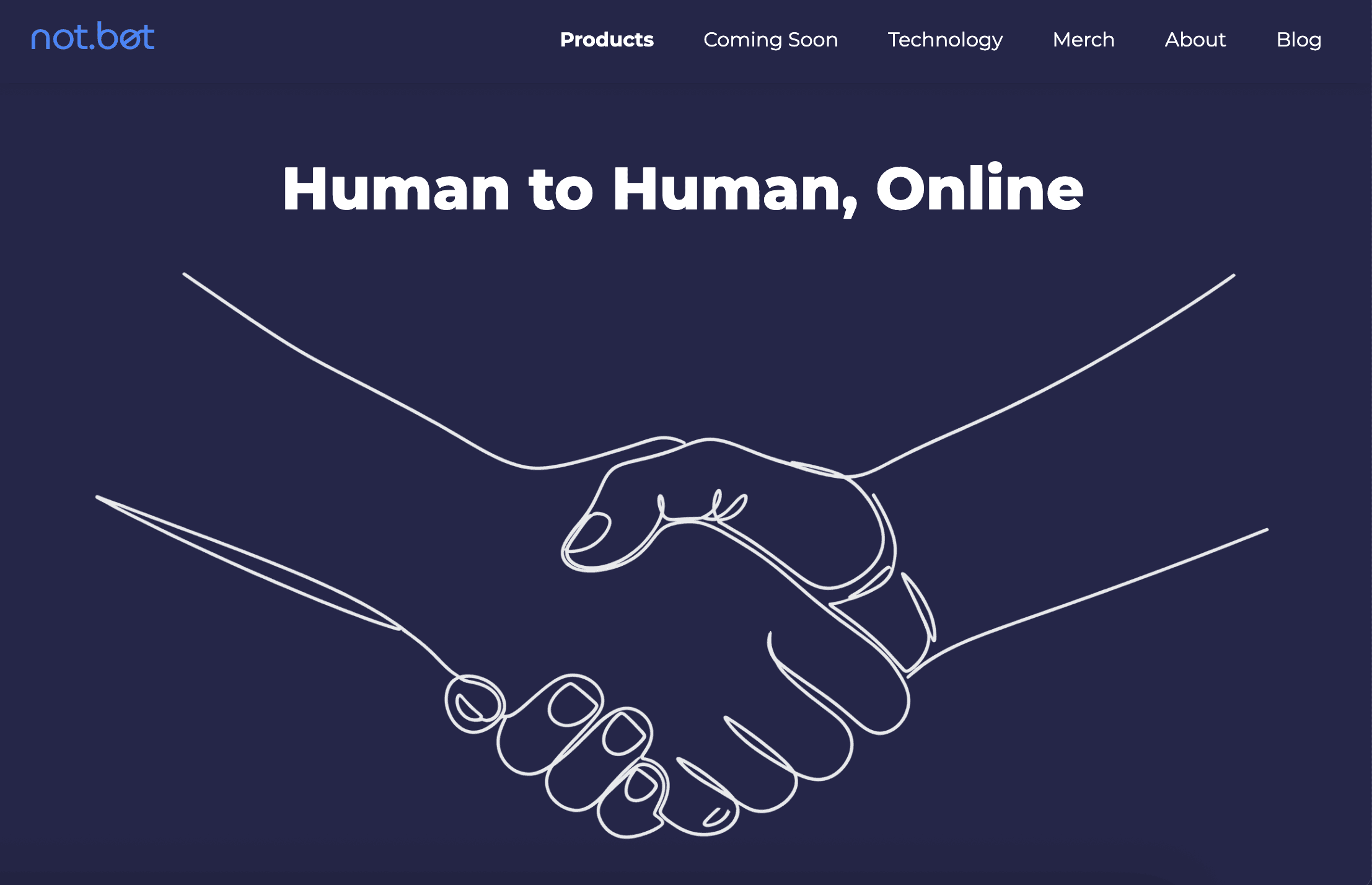
Julia is building a patent-pending way to spot deepfakes and bots without turning the internet into a surveillance state. Instead of playing an endless game of “detect the AI” (which gets harder every month), Julia’s approach is to verify the human behind the content—so when a video, photo, post, or message shows up, people can check whether a real person actually stood behind it and approved it.
At the center of the system is not.bot, a privacy-first identity and signing layer designed for everyday use. With not.bot, people create “stickers” that function like a digital signature you can attach to social posts, dating profiles, emails/DMs, and media like photos and videos. Anyone can scan the sticker to see what was signed and whether it matches the content they’re looking at—making impersonation, reposting, and synthetic manipulation far easier to catch in the real world. The key is specificity: the more clearly a sticker describes what it’s attached to, the harder it is for bad actors to reuse it elsewhere without being exposed.
Julia’s value is also how verification happens. Getting started on not.bot involves scanning a US passport on iPhone, but critically: passport information is stored only on the user’s device. Julia Social (the company behind not.bot) emphasizes that it does not possess users’ passport data, can’t lose it, and can’t leak what it never collected—an intentional design choice that reduces breach risk and aligns incentives toward user safety.
To protect privacy in day-to-day life, Julia supports multiple aliases, so you can maintain separate identities for different contexts (work, personal, public posting, etc.) without those identities being easily linked. Users also get visual identity cues like a LifeHash—a recognizable “visual fingerprint”—and can use higher-capacity JAB codes (similar to supersized QR codes) to embed verification directly into the sticker itself.
Julia’s mission is rooted in a simple idea: in a world flooded with synthetic media, trust can’t rely solely on brittle detection models or centralized databases of personal information. It needs a human-first verification primitive that scales, respects privacy, and works across platforms. Even the name “Julia Social” nods to George Orwell’s 1984—a symbol of protecting agency through privacy.

FAQ
FAQ
01
Who can attend Focus On Risk events?
02
What topics do you cover?
03
What is the guest application process?
04
Do guests receive questions in advance?
05
Can I promote my firm during the podcast?
06
How do I sign up for the newsletter?
07
How do I sponsor or support the show?
01
Who can attend Focus On Risk events?
02
What topics do you cover?
03
What is the guest application process?
04
Do guests receive questions in advance?
05
Can I promote my firm during the podcast?
06
How do I sign up for the newsletter?
07
How do I sponsor or support the show?
Disclaimer
The information provided does not constitute an offer to sell or a solicitation to buy securities. It is for informational purposes only and should not be considered investment advice or endorsement.
By proceeding, you confirm that you are an Accredited Investor under Regulation D of the U.S. Securities Act of 1933, meaning you meet at least one of the following:
• Income: $200,000 annual income ($300,000 with spouse) for the past two years, with expectation of same this year.
• Net Worth: Over $1 million, excluding primary residence.
• Professional: Holder of Series 7, 65, or 82 license.
• Entity: Business/trust with assets over $5 million, or all equity owners are accredited.
• Private Fund Employee: Knowledgeable employee of a qualifying private fund.
By proceeding, you acknowledge these criteria and accept that the information is provided solely for educational purposes.
Overview
Raise: $10M (Equity)
Traction: Channel partners: DataCaliper, Tozny; content providers: Salt & Stream, Jay Gardner
About
Julia is building a patent-pending way to spot deepfakes and bots without turning the internet into a surveillance state. Instead of playing an endless game of “detect the AI” (which gets harder every month), Julia’s approach is to verify the human behind the content—so when a video, photo, post, or message shows up, people can check whether a real person actually stood behind it and approved it.
At the center of the system is not.bot, a privacy-first identity and signing layer designed for everyday use. With not.bot, people create “stickers” that function like a digital signature you can attach to social posts, dating profiles, emails/DMs, and media like photos and videos. Anyone can scan the sticker to see what was signed and whether it matches the content they’re looking at—making impersonation, reposting, and synthetic manipulation far easier to catch in the real world. The key is specificity: the more clearly a sticker describes what it’s attached to, the harder it is for bad actors to reuse it elsewhere without being exposed.
Julia’s value is also how verification happens. Getting started on not.bot involves scanning a US passport on iPhone, but critically: passport information is stored only on the user’s device. Julia Social (the company behind not.bot) emphasizes that it does not possess users’ passport data, can’t lose it, and can’t leak what it never collected—an intentional design choice that reduces breach risk and aligns incentives toward user safety.
To protect privacy in day-to-day life, Julia supports multiple aliases, so you can maintain separate identities for different contexts (work, personal, public posting, etc.) without those identities being easily linked. Users also get visual identity cues like a LifeHash—a recognizable “visual fingerprint”—and can use higher-capacity JAB codes (similar to supersized QR codes) to embed verification directly into the sticker itself.
Julia’s mission is rooted in a simple idea: in a world flooded with synthetic media, trust can’t rely solely on brittle detection models or centralized databases of personal information. It needs a human-first verification primitive that scales, respects privacy, and works across platforms. Even the name “Julia Social” nods to George Orwell’s 1984—a symbol of protecting agency through privacy.
FAQ
01
Who can attend Focus On Risk events?
02
What topics do you cover?
03
What is the guest application process?
04
Do guests receive questions in advance?
05
Can I promote my firm during the podcast?
06
How do I sign up for the newsletter?
07
How do I sponsor or support the show?
Disclaimer
The information provided does not constitute an offer to sell or a solicitation to buy securities. It is for informational purposes only and should not be considered investment advice or endorsement.
By proceeding, you confirm that you are an Accredited Investor under Regulation D of the U.S. Securities Act of 1933, meaning you meet at least one of the following:
• Income: $200,000 annual income ($300,000 with spouse) for the past two years, with expectation of same this year.
• Net Worth: Over $1 million, excluding primary residence.
• Professional: Holder of Series 7, 65, or 82 license.
• Entity: Business/trust with assets over $5 million, or all equity owners are accredited.
• Private Fund Employee: Knowledgeable employee of a qualifying private fund.
By proceeding, you acknowledge these criteria and accept that the information is provided solely for educational purposes.
Overview
Raise: $10M (Equity)
Traction: Channel partners: DataCaliper, Tozny; content providers: Salt & Stream, Jay Gardner
About
Julia is building a patent-pending way to spot deepfakes and bots without turning the internet into a surveillance state. Instead of playing an endless game of “detect the AI” (which gets harder every month), Julia’s approach is to verify the human behind the content—so when a video, photo, post, or message shows up, people can check whether a real person actually stood behind it and approved it.
At the center of the system is not.bot, a privacy-first identity and signing layer designed for everyday use. With not.bot, people create “stickers” that function like a digital signature you can attach to social posts, dating profiles, emails/DMs, and media like photos and videos. Anyone can scan the sticker to see what was signed and whether it matches the content they’re looking at—making impersonation, reposting, and synthetic manipulation far easier to catch in the real world. The key is specificity: the more clearly a sticker describes what it’s attached to, the harder it is for bad actors to reuse it elsewhere without being exposed.
Julia’s value is also how verification happens. Getting started on not.bot involves scanning a US passport on iPhone, but critically: passport information is stored only on the user’s device. Julia Social (the company behind not.bot) emphasizes that it does not possess users’ passport data, can’t lose it, and can’t leak what it never collected—an intentional design choice that reduces breach risk and aligns incentives toward user safety.
To protect privacy in day-to-day life, Julia supports multiple aliases, so you can maintain separate identities for different contexts (work, personal, public posting, etc.) without those identities being easily linked. Users also get visual identity cues like a LifeHash—a recognizable “visual fingerprint”—and can use higher-capacity JAB codes (similar to supersized QR codes) to embed verification directly into the sticker itself.
Julia’s mission is rooted in a simple idea: in a world flooded with synthetic media, trust can’t rely solely on brittle detection models or centralized databases of personal information. It needs a human-first verification primitive that scales, respects privacy, and works across platforms. Even the name “Julia Social” nods to George Orwell’s 1984—a symbol of protecting agency through privacy.
FAQ
Who can attend Focus On Risk events?
What topics do you cover?
What is the guest application process?
Do guests receive questions in advance?
Can I promote my firm during the podcast?
How do I sign up for the newsletter?
How do I sponsor or support the show?